
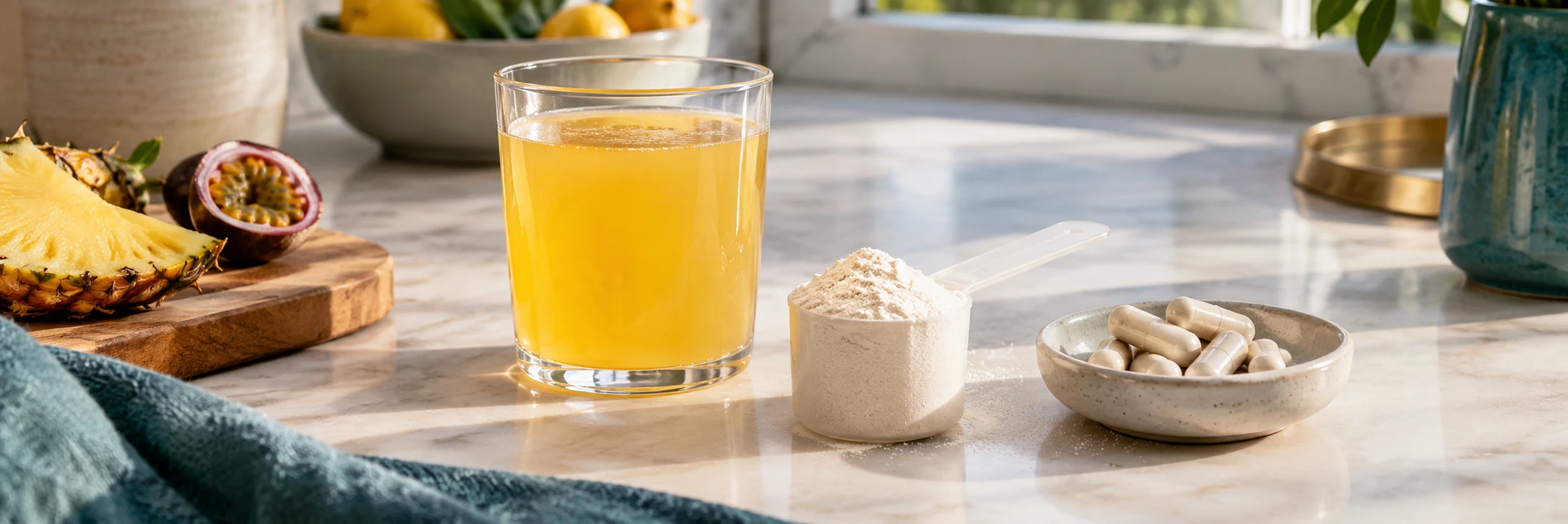
Liquid or powder? Start here.
The main difference is how you take it. Liquid collagen is ready to measure. Powder needs mixing. A liquid format alone does not prove better absorption or bigger benefits. Compare collagen grams, the full blend and the cost of one labeled serving, then choose the format that fits your day.
Which collagen format fits your routine?
Skip the format hype. Start with the part you will actually do each day: pour, mix or swallow. The ingredient list tells you what you are buying; the format tells you how you will take it.
| What matters | Liquid | Powder | Capsules |
|---|---|---|---|
| Preparation | Measure the labeled pour | Measure and mix the labeled scoop | Take the labeled capsule number with water |
| Best routine fit | You prefer a ready, flavored liquid | You want to mix collagen into a drink | You prefer swallowing capsules |
| Compare the serving | Collagen grams per measured amount | Collagen grams per scoop, not total scoop weight | Collagen grams per full serving, not capsule count |
| Check before buying | Flavor and storage after opening | Flavor, mixing directions and added ingredients | Capsule size, shell ingredients and capsules per serving |
Three useful ways to decide.
- Prefer a measured pour? A ready liquid avoids mixing a scoop. Check its flavor, serving volume and storage instructions.
- Already make a shake or smoothie? Powder can fit that routine. Check the individual product's mixing directions and whether it is flavored.
- Want a swallowable format? Count how many capsules make the full serving. One capsule may not provide the same collagen amount as a pour or scoop.
Does liquid collagen absorb better than powder?
A universal liquid-over-powder advantage is not established by the research cited here. Hydrolyzed collagen has been broken into smaller peptides. Both liquid and powder products can contain these peptides, so being a liquid does not automatically make a product more effective.
Oral collagen studies use different preparations, amounts and outcomes. The 2019 systematic review discusses skin-related findings; it does not establish that every liquid absorbs faster than an equivalent powder or test Super Collagen Joint Plus. Treat a precise absorption percentage or a promise of faster results as something to verify, not a reason to buy on its own.
What does each labeled serving cost?
Divide the price by the labeled servings. Then check collagen grams per serving. A larger scoop or bottle is not automatically a better deal, and a lower price does not mean an equivalent formula.
| Our liquid bottles | 16 fl oz | 32 fl oz |
|---|---|---|
| Collagen per 30 mL | 6,000 mg | 6,000 mg |
| Vitamin C per 30 mL | 100 mg | 100 mg |
| Labeled servings | 16 | 32 |
| One-time price | $29.99 | $44.99 |
| One-time cost per serving | $1.87 | $1.41 |
| Optional monthly subscription | $26.99 | $40.49 |
| Subscription cost per serving | $1.69 | $1.27 |
| Choose it for | A smaller first purchase | More servings and lower cost per serving |
Prices checked October 9, 2026. USD before tax and shipping. Per-serving figures are rounded to the nearest cent. Subscription is optional and recurring. Both sizes list a 30 mL serving; servings per bottle are not necessarily days of use.
16 oz lowers the starting purchase. 32 oz lowers the cost per serving. The 32 oz bottle has twice the labeled servings for $15 more at the one-time price. Its serving is the same strength. Compare both bottles and purchase options.
How to compare a liquid with a powder fairly.
Use the actual collagen amount, not the full weight of a flavored scoop. Separate collagen from vitamins, minerals and other ingredients. Compare one-time prices with one-time prices, or subscription prices with their recurring terms. Cost per serving helps compare purchases; it does not predict health results.
An actual powder option to compare
Check the Collagen +Probiotics powder label: each 10.2 g scoop supplies 10 g of collagen peptides. The 277 g tub has 27 labeled servings.
This is a different formula from Joint Plus liquid. It includes a probiotic blend, vitamin C, biotin and hyaluronic acid. A larger collagen amount per serving does not guarantee better results.
Currently Sold out, checked October 16, 2026. Its listed one-time price is $39.99, about $1.48 per labeled serving before tax and shipping. Follow the current tub's mixing directions; 27 servings is not a fixed number of days.
What is inside our liquid collagen?
Super Collagen Joint Plus is a blend, not collagen alone. Each 30 mL serving lists 6 g of collagen peptides and 100 mg vitamin C, plus glucosamine, MSM, chondroitin, turmeric, hyaluronic acid and tart cherry. Vitamin C supports normal collagen formation, including connective tissue. Check the complete Supplement Facts for each ingredient's amount.
Choose the 16 oz bottle for a smaller first purchase, or the 32 oz bottle for more servings at a lower per-serving price. Both have the same listed formula and tropical flavor. Neither is a vegan collagen option.
Four details to check before buying.
- Collagen amount: compare grams per complete labeled serving.
- Source and full blend: review animal sources, allergens and every added ingredient.
- Directions and storage: follow your current package, including instructions after opening.
- Purchase terms: check total price, shipping and whether you selected a recurring subscription.
Keep balanced meals and adequate dietary protein in the routine. If you are pregnant, nursing, taking medication or managing a medical condition, ask a healthcare professional about the full formula before use.
Questions before you choose
Is liquid collagen better than powder?
It can be a better fit if you prefer a ready, measured pour. Powder can fit people who already mix a drink. Neither format alone establishes better absorption or results. Compare the full formulas and collagen grams per serving.
Is hydrolyzed collagen the same as collagen peptides?
Hydrolyzed collagen has been broken into smaller pieces called peptides. The terms describe processing, not a guarantee that one delivery format outperforms another.
Which is better value, 16 oz or 32 oz?
For our bottles, 16 oz has the lower one-time price at $29.99. The 32 oz bottle costs $44.99 and has twice the labeled servings, giving it the lower cost per serving. Both list 6 g collagen per 30 mL. See the size comparison.
Can I compare a collagen capsule count with a scoop?
Compare collagen grams per full serving instead. Read how many capsules make that serving, and separate collagen weight from a powder scoop's other ingredients.
Does more collagen mean faster results?
A larger amount is not a guarantee of faster or better results. Follow the current label and compare the complete formula instead of increasing the serving.
Sources and scope
Educational information, not personal medical advice. Nutra Botanics sells products in this category. Ingredient research does not establish the results of our finished formulas. This update does not claim independent clinical review.