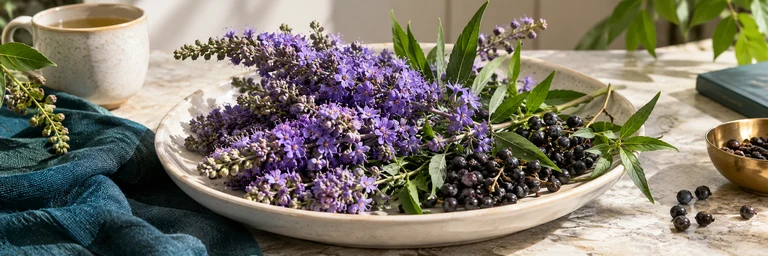

Some ingredients have promising research for specific symptoms. That does not make “hormone balance” a proven benefit of every bottle. PMS, hot flashes, stress and sleep problems are different concerns. A useful study needs to address the concern you actually have.
This review compares vitex, black cohosh, ashwagandha, maca, DIM and evening primrose oil. It separates symptom results from changes in laboratory markers, then explains what to check before choosing a formula.
What to know first
- Vitex research is mainly about PMS. Different extracts and study quality matter.
- Stress research is not proof of cycle regulation. Ashwagandha studies cannot answer every women’s health question.
- A changed lab marker is not the same as feeling better. This distinction matters for DIM.
- A bigger ingredient list is not proof of a stronger formula. Check the complete serving and relevant safety questions.
Start with the symptom, not a hormone-balance claim
Before comparing ingredients, name the problem: breast tenderness before a period, hot flashes, poor sleep or another change. “Hormone balance” alone does not tell you which outcome a product should help.
Researchers may measure symptoms, sleep scores or a hormone-related marker. These are different results. A change in cortisol or an estrogen breakdown product does not, by itself, show that periods become regular or menopause symptoms improve.
New, persistent or disruptive symptoms deserve medical advice. A supplement label cannot diagnose their cause. Use the symptom-first perimenopause, PMS and menopause guide to prepare useful questions.
Vitex and PMS: promising trials, different extracts
Vitex, also called chasteberry, has been studied for PMS symptoms. In Schellenberg’s 2001 trial, 170 women were evaluated over three menstrual cycles. A specified Ze 440 fruit extract performed better than placebo on the study’s symptom measures.
Van Die’s 2013 review included eight PMS trials. Seven reported a positive result, and five of the six placebo-controlled trials favored vitex. Verkaik’s 2017 review also found promising results, but raised concerns about study quality and likely overestimation.
The label lesson: whole fruit, a dry extract and a standardized extract are not automatically interchangeable. A 400 mg label claim does not establish that a product matches a trial preparation. Three cycles of observation also do not prove that every person needs exactly three cycles to reach a full effect.
NCCIH’s chasteberry guidance says stronger evidence is needed for firm conclusions. It also flags pregnancy, breastfeeding and hormone-sensitive conditions. Read the detailed vitex research and label guide before comparing a product with these trials.
Black cohosh and hot flashes: read the full picture
Black cohosh has been studied for menopausal symptoms, but results vary. The 2012 Cochrane review found insufficient evidence to support it for menopausal symptoms. It did not show a significant benefit over placebo for hot-flash frequency in the pooled comparison.
NCCIH’s current summary notes a later review with potentially beneficial findings for some symptoms. That does not establish the same effect for every extract. The 2023 Menopause Society statement does not recommend supplements or herbal remedies for hot flashes and night sweats.
The practical decision: if hot flashes are your main concern, discuss established treatment options instead of treating a generic relief percentage as a promise. Black cohosh also needs a safety review. Liver injury has been reported, although a direct cause is not established in every report.
Ashwagandha, maca and DIM ask different research questions
Ashwagandha: stress and sleep research
Salve’s 2019 trial studied 60 adults with stress for eight weeks using specified root-extract preparations. It reported improvements in perceived stress, cortisol and sleep measures. It did not establish that a general women’s hormone blend regulates periods or improves libido.
A separate Lopresti trial studied aging, overweight men using a different preparation. It did not find a significant between-group cortisol difference. It should not be used as proof of a women’s cycle or cortisol benefit.
NCCIH’s ashwagandha guidance distinguishes possible stress or insomnia benefits from unproven broader uses. Pregnancy, breastfeeding, thyroid or autoimmune conditions and medicine interactions matter. Rare liver injury has also been reported.
Maca: a small symptom study is not a hormone-reset result
Brooks’ 2008 study involved 14 postmenopausal women. They took 3.5 g of maca daily for six weeks and placebo for six weeks. Some mood and sexual-function scores improved, without a measured change in the studied reproductive hormones.
This small result does not establish broad symptom relief, a universal dose or a mechanism that resets hormone signaling. Larger studies and the actual preparation matter. Read the maca guide for a closer look at this ingredient.
DIM: estrogen breakdown markers are not symptom relief
DIM stands for diindolylmethane. Dalessandri’s small 2004 trial studied urinary estrogen breakdown products in postmenopausal women with a breast-cancer history. It was not a trial of PMS or heavy-period relief. The older Michnovicz study tested indole-3-carbinol, a different ingredient.
In a 2017 trial in women taking tamoxifen, DIM changed some markers but also lowered endoxifen, an active tamoxifen metabolite. The authors called for further study of the interaction. If you take tamoxifen, discuss DIM with your oncology team before using it.
The label lesson: a claim about estrogen metabolism does not demonstrate relief of breast tenderness, heavy bleeding or a condition described as “estrogen dominance.” Nor do separate ingredient trials prove that a four-ingredient blend works better.
Evening primrose, soy and common label claims
- Evening primrose oil: NCCIH finds insufficient evidence for PMS or menopause symptoms. An explanation about fatty acids is not proof of symptom relief.
- Soy supplements: the 2023 Menopause Society statement does not recommend soy extracts or equol for hot flashes. That does not mean ordinary soy food has no nutritional value.
- Over-the-counter progesterone creams: a cream marketed for symptoms should not be treated as interchangeable with prescribed hormone treatment. Discuss it with a clinician rather than adjusting hormones yourself.
- “Adrenal fatigue” claims: the Endocrine Society explains that this is not a recognized medical diagnosis. Ongoing fatigue needs an assessment of its cause.
- Long multivitamin blends: count the amount in a complete serving. The number of ingredients does not tell you whether a blend matches a study or meets your own nutritional needs.
How to compare the actual formula with the research
- Check the outcome. Was the study about your symptom, a sleep score or a laboratory marker?
- Check the people. A study in men or a small group of postmenopausal women does not answer every question about PMS.
- Check the preparation. Look for the plant part, extract details and amount per complete serving. Do not convert extract strength from the ingredient name alone.
- Check the whole label. Include other supplements and medicines in the safety review. More overlapping ingredients can create more questions.
- Choose a useful review point. Track the concern you started with. Do not use a trial’s duration as a guaranteed results deadline.
Bring the full product label and a short symptom record to a clinician or pharmacist. That is more useful than asking whether a bottle “balances hormones.”
Your next step: choose by the concern and the complete label
Vitex has promising PMS trials. Some ashwagandha preparations have stress and sleep research. Black cohosh findings vary, while maca and DIM studies answer narrower questions. None of this proves that an untested blend resets hormones or replaces medical care.
For a practical next step, compare perimenopause nutrient needs and supplement purposes. Then check the actual product’s serving, directions and precautions. Keep symptom treatment and routine nutritional support separate.
This article explains research and label questions. It is educational information, not a diagnosis or a personal treatment plan.
These statements have not been evaluated by the Food and Drug Administration. This product is not intended to diagnose, treat, cure, or prevent any disease.
Frequently Asked Questions
Do hormone-balancing supplements for women actually work?
How much of a symptom shift can I expect from vitex or black cohosh?
How fast do women's hormone supplements work?
Which women's hormone-balancing ingredients have the strongest research base?
Are hormone-balancing supplements safe for women?
Can supplements replace HRT or medical treatment?

Explore the formulas
Explore current ingredients, directions and Supplement Facts before choosing your formula.
Browse all formulas