
Some L-carnitine studies have found better exercise recovery and small average changes in body weight. The useful answer depends on the form studied, the people involved and what researchers measured.
This review helps you separate those findings from a supplement's sales pitch. Start with your goal, then check whether the research actually matches the bottle you are considering.
Start with these three checks
- Recovery is not the same as performance. Less soreness does not automatically mean more strength or faster race times.
- Forms matter. A tartrate trial does not establish the same result for every liquid or capsule.
- Research is not a serving instruction. Follow your current label and review its precautions.
What does carnitine actually do?
Carnitine carries fatty acids into the parts of cells that use them for energy. Healthy adults generally make enough. Its normal role in fat metabolism does not mean taking more will automatically burn more stored body fat.
For the basics, read the complete L-carnitine guide. Here, the question is what taking a supplement changed in the studies.
In a 2011 trial by Wall and colleagues, 14 healthy men followed a specific carnitine-tartrate and carbohydrate-drink routine for 24 weeks. Researchers found increased muscle carnitine and changes in exercise fuel use.
That small, specific protocol does not establish that every user needs a sugary drink, a carbohydrate meal or a 24-week waiting period. It also is not a single-dose pre-workout test.
Recovery: what improved in the trials?
Several exercise studies used L-carnitine L-tartrate, often shortened to LCLT. Check that full name before comparing their findings with a product.
- A three-week trial in trained men. A 2002 study that compared each participant's responses involved 10 men and supplied 2 g of L-carnitine daily as LCLT. After repeated squats, blood markers and scans showed less muscle tissue disruption than with placebo.
- Soreness and strength were different results. In a 2010 study of 18 middle-aged men and women, about three weeks of tartrate supplementation reduced soreness and some recovery markers after an exercise challenge. Measured strength and power did not improve.
- A larger five-week recovery trial. In a 2021 trial completed by 73 people, the tartrate group reported better recovery and less soreness, with smaller declines in strength and power after a demanding workout.
These are reasons to look closely at recovery research. They are not proof that every carnitine preparation makes you stronger. Our exercise and recovery guide explains that distinction.
Weight change: put the average in perspective
A 2016 review of nine trials, totaling 911 participants, found an average weight difference of 1.33 kg, about 2.9 lb, favoring carnitine over the comparison groups.
A 2020 review of 37 trials, with 2,292 participants, found a smaller average difference of 1.21 kg, about 2.7 lb. Overall waist size and body-fat percentage did not significantly improve.
The higher-quality trials in that later review confirmed only the body-weight finding. Neither pooled average predicts your result or proves an effect for a particular finished supplement.
Use the weight-loss evidence guide if that is your goal. Fatigue is a separate question: feeling persistently tired deserves a healthcare conversation rather than assuming a carnitine supplement is the answer.
Acetyl-L-carnitine is a different research topic
Acetyl-L-carnitine, or ALCAR, is not the same named form as LCLT. Studies of ALCAR in people with memory disorders cannot establish a brain benefit for an ordinary exercise or metabolism formula.
The Cochrane review of acetyl-L-carnitine for dementia did not support routine clinical use. Its authors found no convincing benefit across objective measures of cognition and function.
Do not read that disease-specific research as a reason to use a shopping supplement for memory treatment. The current Nutra Botanics liquid label names L-carnitine, not acetyl-L-carnitine.
Skip the universal dose and deadline rules
Different trials ask different questions. A three-week soreness study and a 24-week muscle-content study do not establish one timeline for every possible benefit.
Nor do they establish a universal 2 g minimum, a mandatory carbohydrate meal or a dependable pre-workout fat-burning effect. Increasing your serving does not make a different product match a study.
When comparing research, ask: Was the same form used? Were the participants similar to me? Was the measured result the one I want? The supplement buying guide turns those questions into a practical checklist.
Match your goal, not a “best responder” label
Age, a plant-based diet or being new to training does not guarantee a stronger response. Healthy vegetarians generally make enough carnitine; lower dietary intake alone does not establish a need for a supplement.
Choose the outcome you care about first. Then compare the actual participants and preparation with your situation. Avoid treating an ingredient's normal role, a recovery marker and a body-weight change as interchangeable benefits.
What should you check on the bottle?
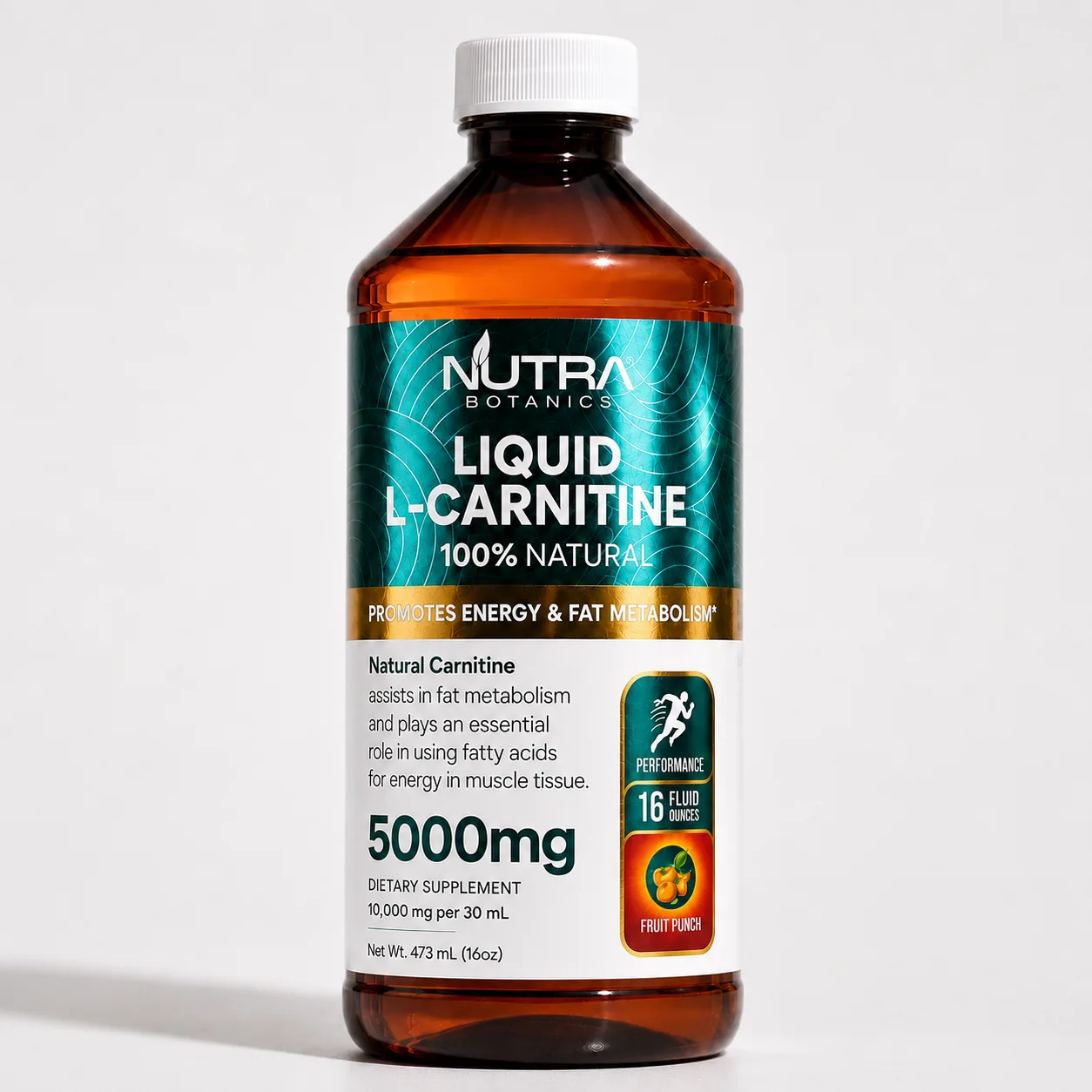
For Nutra Botanics Liquid L-Carnitine, the practical features are a fruit-punch liquid, vitamin B5 and no added stimulants. The label does not identify the carnitine as L-tartrate, so the recovery trials above do not verify this formula's effect.
The current serving lists 5,000 mg of L-carnitine and 10 mg of vitamin B5 per measuring tablespoon, approximately 15 mL. The manufacturer says to shake well and use one measuring tablespoon daily, directly or mixed in water or juice.
Its front-label 10,000 mg per 30 mL refers to twice that volume, not an instruction to double the serving. The serving-size guide explains the measures.
Prefer a measured pour or a pill? Compare the practical differences in the liquid versus capsule guide.
Read the precautions before choosing
NIH reports nausea, vomiting, cramps, diarrhea and fishy body odor at about 3 g daily. The current product's 5 g serving exceeds that amount. Review suitability with a healthcare professional before use.
Kidney disease, seizure disorders and medicines need particular attention. NIH also discusses TMAO, a substance made by gut bacteria, and possible cardiovascular concerns; the long-term implications remain unsettled.
The manufacturer advises physician consultation during pregnancy or nursing, with medicines or with a medical condition. A blanket “safe long term” claim does not replace that check.
Quick answers before you choose
Amounts and forms differ by trial. A study amount does not establish the right serving for every product or person. Follow the current manufacturer directions and review the full precautions instead of copying a research protocol.
The trials discussed here range from three-week recovery studies to a 24-week muscle-content study. The different results measured do not establish one deadline for personal results or a universal minimum waiting period.
Recovery studies assess what happens after exercise. Weight-change studies ask a different question. Findings for one goal do not demonstrate another benefit, and a supplement does not replace your food and activity plan.
A carbohydrate drink was part of the specific Wall exercise trial. That does not create a rule for every product. The current Nutra Botanics directions allow the measured serving directly or mixed in water or juice.
There is no blanket assurance for every user or serving. Check the full label and precautions with a healthcare professional, especially if you take medicines or have a medical condition.
They have different research histories, not a proven universal winner. The recovery trials described here used tartrate. Acetyl-L-carnitine studies in memory disorders do not establish an exercise benefit or a benefit for the current liquid formula.
These statements have not been evaluated by the Food and Drug Administration. This product is not intended to diagnose, treat, cure, or prevent any disease.
Research and label sources
Nutra Botanics publishes this guide and sells supplements. Ingredient studies do not demonstrate a result for this finished formula.
- NIH: normal carnitine roles and precautions
- Wall et al. (2011): muscle-content and exercise trial
- Volek et al. (2002): recovery markers after squats
- Ho et al. (2010): soreness and performance measured separately
- Stefan et al. (2021): five-week recovery trial
- Pooyandjoo et al. (2016): nine-trial weight review
- Talenezhad et al. (2020): 37-trial body-composition review
- Cochrane: acetyl-L-carnitine for dementia
- Product facts checked against the retained manufacturer label and current product page.