
Key Takeaways
- Stress eating is hormonal, not behavioral. Chronic cortisol elevation drives sweet/salty cravings and visceral fat storage; willpower interventions don't address the upstream signal
- Ashwagandha 300mg twice daily for 8 weeks reduced food cravings (Lack of Control p=0.0097, Emotional Eating p=0.0068), serum cortisol (−3.83 vs −1.32 µg/dL), and body weight (−2.32 vs −1.13 kg) vs placebo (Choudhary 2017)
- Cortisol-lowering effect confirmed in 60-day Salve 2019 RCT at both 250mg and 600mg/day doses (Salve 2019)
- Stack with glucomannan (acute satiety) for full coverage of both stress-driven and meal-time hunger signals
- Use a standardized extract (KSM-66 or Sensoril) — withanolide content matters more than total root weight
- Skip ashwagandha if pregnant, breastfeeding, hyperthyroid, or on immunosuppressants — talk to your physician first
Related reading: Glucomannan for Appetite Control, Natural Appetite Suppressants, How to Control Food Cravings, Ashwagandha for Testosterone.
The Cortisol-Craving Loop: Why Stress Eating Isn't About Willpower
Chronic stress activates the hypothalamic-pituitary-adrenal (HPA) axis, sustaining elevated cortisol throughout the day. Cortisol's job is to mobilize energy — but in modern life, that energy is rarely burned. Instead, it triggers a hormonal cascade that drives specific food-seeking behavior: increased neuropeptide Y (a hunger neuropeptide that biases preference toward high-density "comfort" foods), suppressed leptin sensitivity (so satiety signals are blunted), and increased visceral fat storage as the body prepares for a perceived threat.
This is why interventions that target eating behavior — calorie counting, portion control, "just eat less" — often fail in chronically stressed people. The hunger and craving signals being overridden are themselves dysregulated. The upstream signal is cortisol; until that's normalized, the downstream behavior is fighting biology. Adaptogens are a category of botanicals that act on the HPA axis to bring cortisol output back toward baseline — addressing the source rather than the symptom.
How Ashwagandha Modulates the Stress Response
Ashwagandha (Withania somnifera) is the most-studied adaptogen for cortisol modulation. Its active compounds — withanolides, particularly withaferin A and withanolide A — appear to act on multiple HPA-axis targets: GABAergic signaling in the brain (calming), serotonin pathway modulation, and direct effects on adrenal cortisol output. The net result in stressed populations is reduced morning serum cortisol, lower self-reported stress scores, and improved markers of HPA recovery after a stressor.
A 60-day double-blind RCT in 60 stressed adults found ashwagandha at both 250mg and 600mg/day significantly reduced serum cortisol versus placebo, with the higher dose showing the larger effect (Salve 2019). This is the mechanistic foundation for the appetite/weight findings — when cortisol normalizes, the downstream cravings, comfort-food bias, and visceral storage signal all attenuate.
The Choudhary 2017 Trial: Direct Evidence in Stressed Eaters
The most directly relevant trial for the appetite-suppressant question is Choudhary 2017 — a randomized, double-blind, placebo-controlled study of 52 chronically stressed adults given a standardized ashwagandha root extract (300mg twice daily) for 8 weeks. The trial measured both stress/eating behavior outcomes and biological markers (Choudhary 2017).
Results vs placebo: significant reductions in Food Cravings Questionnaire scores — Lack of Control over eating (p=0.0097), Emotional Eating subscale (p=0.0068), and Hunger subscale. Serum cortisol dropped −3.83 µg/dL in the ashwagandha arm vs −1.32 µg/dL in placebo. Body weight fell −2.32 kg vs −1.13 kg, and BMI fell −0.91 vs −0.42. Notably, the trial enrolled stressed adults specifically — not a general weight-loss population — which is exactly the audience for whom adaptogen appetite suppression is indicated.
Choudhary 2017 is the only RCT to directly measure cortisol, food cravings, and weight in the same cohort with a standardized ashwagandha extract — and all three moved in the predicted direction with statistical significance.
Ashwagandha vs Glucomannan: Different Tools for Different Hunger
Adaptogens and bulk-fiber suppressants like glucomannan are not interchangeable — they treat different mechanisms. Glucomannan works mechanically: it expands in the stomach to physically signal fullness via stretch receptors and slowed gastric emptying. Its effect is acute (30-45 min) and meal-bound. It's the right tool for "I sit down to dinner ravenous and overeat."
Ashwagandha works hormonally: it lowers the cortisol drive that produces between-meal cravings, evening "I'm not hungry but I want something sweet" pulls, and stress-triggered comfort eating. Its effect is cumulative (8 weeks to peak) and continuous. It's the right tool for "I eat fine at meals but I can't stop snacking when I'm stressed." For people whose hunger is both meal-driven and stress-driven, the two stack cleanly — glucomannan with meals, ashwagandha morning + evening.
The Adaptogen Appetite Protocol
The Choudhary 2017 protocol — 300mg twice daily of a standardized ashwagandha root extract for 8+ weeks — is the dose with direct appetite/weight outcome evidence. Choose a standardized extract (KSM-66, Sensoril, or equivalent) listing withanolide content (typically 5%+); raw ashwagandha root powder lacks the withanolide concentration used in the trials. Take with food to improve absorption and reduce the rare GI upset.
Timing: morning + evening for 24-hour cortisol coverage. Some protocols use a single 600mg evening dose for sleep-driven cortisol elevation, but the split-dose 300mg twice daily approach has the strongest direct trial backing for appetite outcomes. Pair with stress-reduction practices (sleep ≥7 hours, walking, breathwork) — ashwagandha modulates the cortisol response but doesn't substitute for removing the stressor. For meal-time hunger, layer in glucomannan 1g before main meals.
Safety, Caveats, and Who Should Skip It
Ashwagandha is generally well-tolerated in 8-12 week trials, with mild GI upset being the most common reported side effect. However, the safety profile has clear contraindications that disqualify a meaningful subset of users — and these are not edge cases:
Pregnancy/breastfeeding: contraindicated. Withanolides have abortifacient activity in animal models and ashwagandha is traditionally avoided during pregnancy. Hyperthyroidism / autoimmune thyroid disease: ashwagandha can increase T4/T3 output and is contraindicated in hyperthyroid states; can interact with thyroid medication in hypothyroid patients on levothyroxine. Autoimmune conditions (lupus, MS, RA, Hashimoto's): ashwagandha has immunostimulating activity and is often advised against in autoimmune protocols. Immunosuppressant medication: may counteract the medication. Sedative/benzodiazepine medication: additive sedation possible. Rare cases of ashwagandha-associated liver injury have been reported in case series, though causality is unclear and the absolute risk appears very low at standard doses. If you have any of the above conditions or take any of the above medications, talk to your physician before starting ashwagandha — adaptogen ≠ inert.
NutraBotanics Appetrol
Targets stress-driven cravings with adaptogenic ashwagandha plus chromium for blood-sugar stability and garcinia cambogia for appetite signaling — the cortisol-pathway approach to appetite control.
Shop Appetrol →Frequently Asked Questions
What is an adaptogen appetite suppressant and how is it different from a regular appetite suppressant?
Does ashwagandha actually reduce food cravings in clinical trials?
How long does ashwagandha take to work for stress eating?
What dose of ashwagandha should I take for appetite control?
Can I stack ashwagandha with glucomannan or other appetite suppressants?
Who should not take ashwagandha?

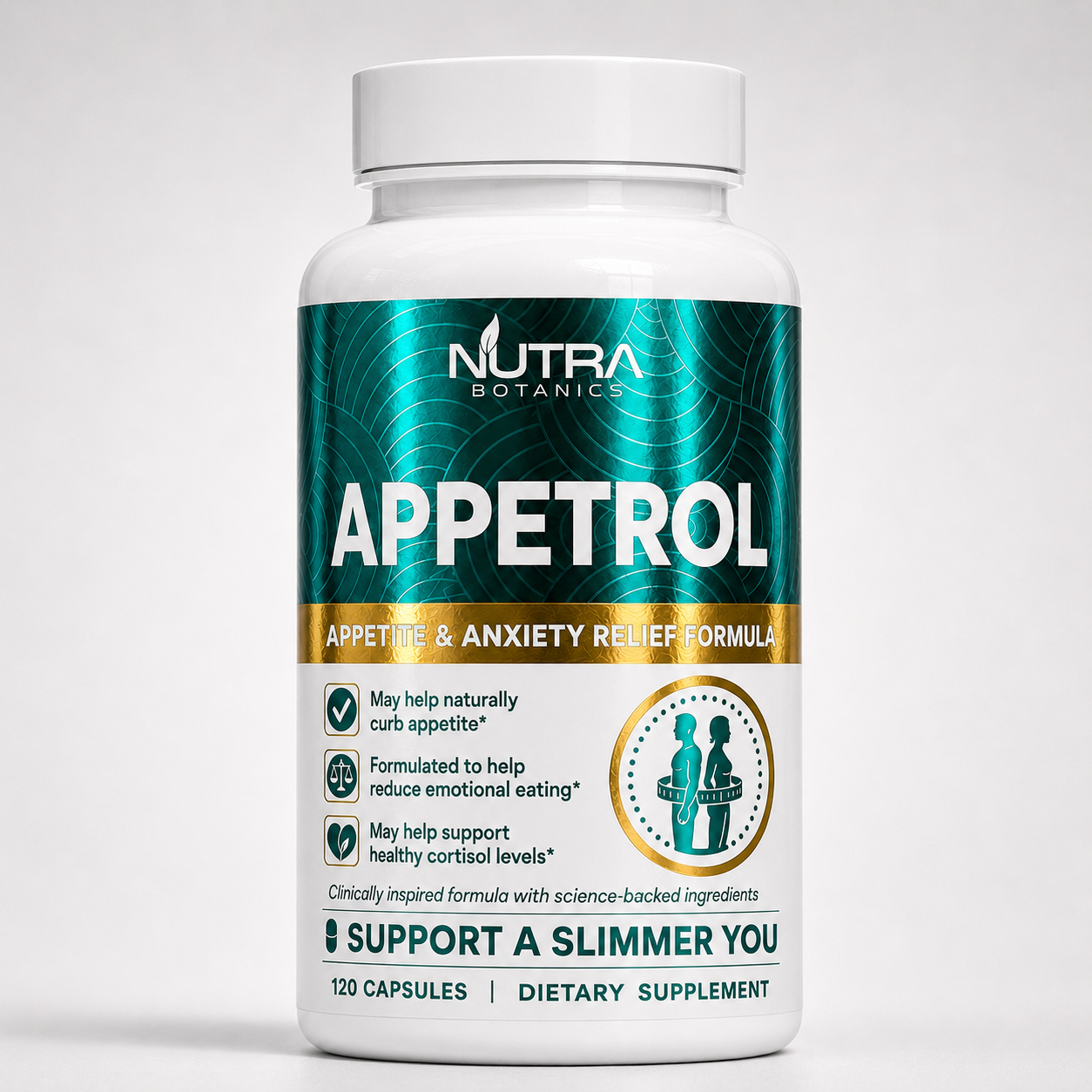
Appetrol
Cortisol-pathway appetite support: ashwagandha + chromium + garcinia cambogia
- Ashwagandha root extract for stress-driven craving modulation
- Chromium picolinate for blood-sugar / craving stability
- Garcinia cambogia for satiety signaling
Studied dose protocolFree shipping over $75
Shop AppetrolWeight-Management Range
Compare adaptogen, fiber, and metabolic-pathway formulas side by side
- Glucomannan (mechanical satiety) for meal-time hunger
- L-Carnitine + CLA for fatty-acid oxidation pathway
- Filter by mechanism, not marketing
Browse the categorySubscribe & save 20%
Shop Weight Management