
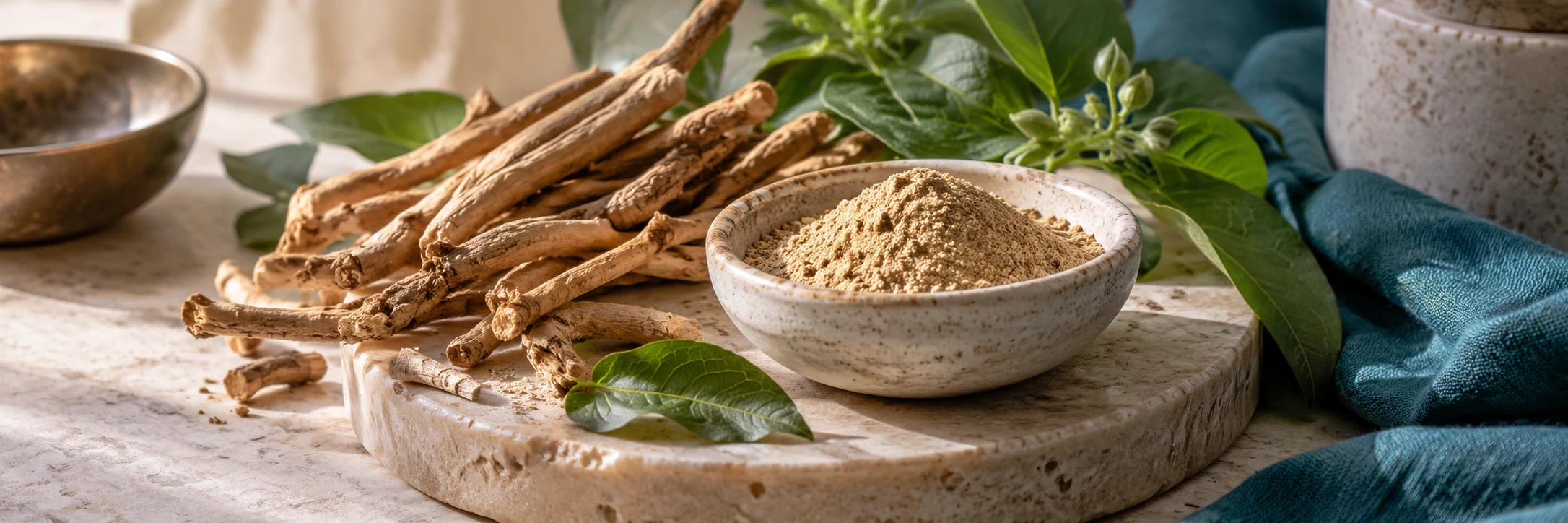
Does ashwagandha increase testosterone? Some human trials have found increases with specific extracts. The useful question is which preparation was tested, who took it and whether the outcome was measured in blood, saliva or a questionnaire. Those details make the research more useful when you compare a bottle.
Four details that matter
- Blood testosterone and salivary testosterone are different measurements.
- A training result, a fertility result and a sexual-health score answer different questions.
- Extract names and specifications matter as much as the milligram amount.
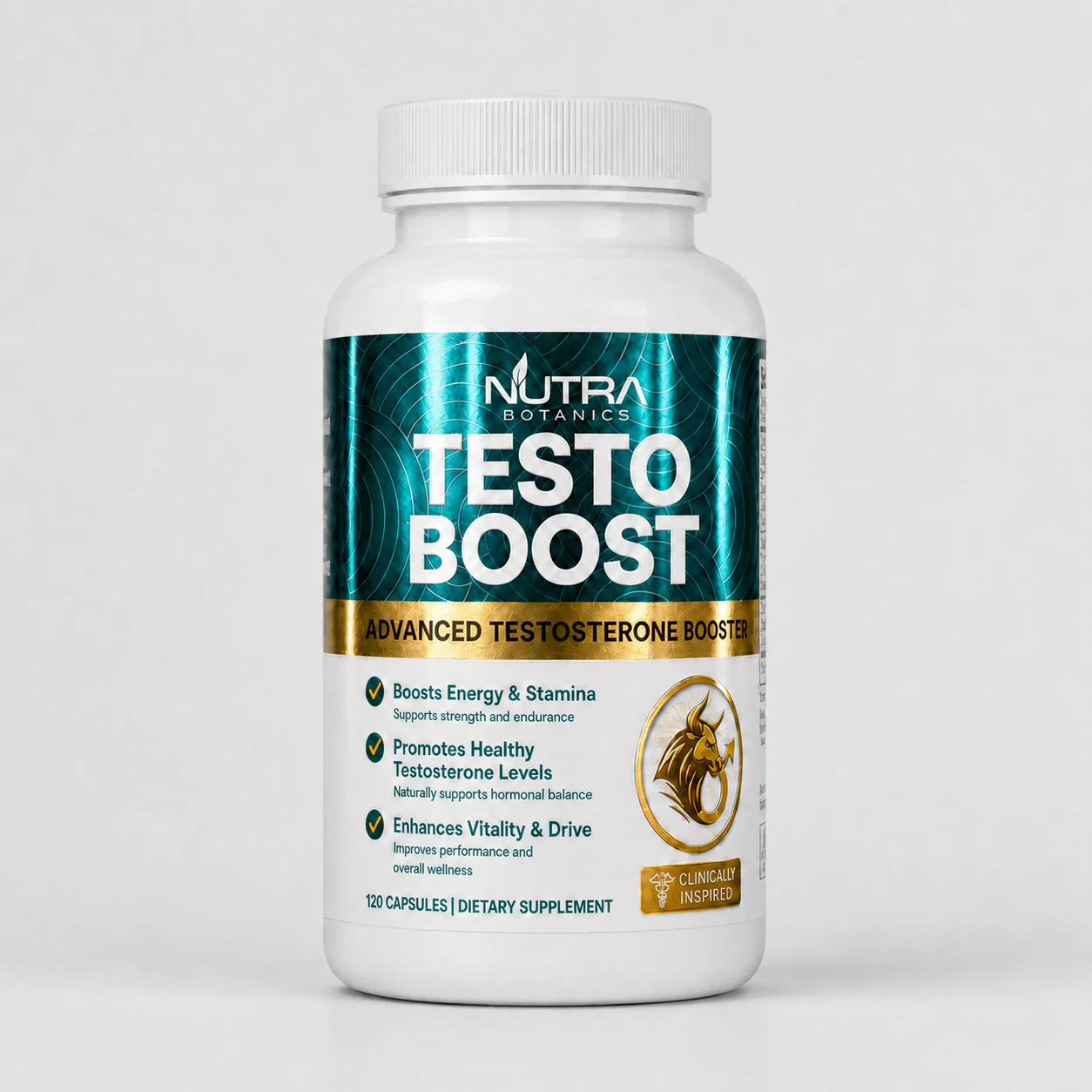
- Testo Boost lists 500 mg of ashwagandha extract standardized to 5% withanolides, without identifying a branded extract.
Stress research and testosterone research are different
Ashwagandha is often discussed as an adaptogen in stress and everyday wellbeing. In a 2012 randomized stress trial, 64 adults with chronic stress received a root extract or placebo for 60 days. The extract group had better stress-questionnaire results and lower serum cortisol. Testosterone was not an outcome, so this study does not show that lowering cortisol raised testosterone.
The hormone trial discussed below did not find a significant cortisol difference. That makes a simple “less cortisol means more testosterone” explanation too broad for these results. Read each measured outcome on its own.
What the human trials actually measured
These studies tested different preparations and groups. Their percentages should not be combined into an expected result for every ashwagandha supplement.
| Study and participants | Preparation and period | Reported outcome |
|---|---|---|
| Wankhede, 2015 57 men with little prior resistance-training experience; 50 completed | 600 mg daily of KSM-66 root extract, with training for eight weeks | Serum testosterone changed by 96.2 ng/dL versus 18.0 ng/dL with placebo; between-group p = 0.004 |
| Lopresti, 2019 Overweight men aged 40 to 70 with mild fatigue | Shoden preparation delivering 21 mg daily of withanolide glycosides; eight-week treatment phases | Salivary testosterone was 14.7% higher relative to placebo |
| Mutha, 2025 100 men randomized; 93 in the per-protocol analysis | 300 mg root extract twice daily for eight weeks | Improvements in sexual-health questionnaires and semen measures; a different question from a blood-test change |
Keep the endpoint in view. The Lopresti trial found no significant between-group benefit for fatigue, vigor, sexual wellbeing or psychological wellbeing. A hormone measurement does not establish those improvements by itself. The newer Mutha trial adds information about sexual-health outcomes, but the abstract alone should not be used to assign a hormone result to another formula.
The often-repeated “nine clinical studies” headline needs context. A 2021 review included 32 trials across 13 herbs, with nine positive testosterone findings across the entire set. It identified positive findings for some ashwagandha and fenugreek preparations. That is not a count of nine positive ashwagandha trials. Only six included studies had a low risk of bias.
Fertility research: a specific population
In the 2013 Ambiye pilot trial, 46 men with low sperm concentration received placebo or 675 mg daily of standardized ashwagandha root extract for 90 days. Serum testosterone increased 17% from baseline in the extract group. This is a within-group change, not a 17% advantage over placebo.
Semen measures also improved, but the trial did not establish a pregnancy or live-birth benefit. Its small sample and fertility-related entry criteria matter. Results in these participants cannot be treated as the expected response in all men, or as evidence that Testo Boost treats infertility.
Training results: strength and size measurements
The Wankhede trial reported larger improvements in bench-press and leg-extension strength with the extract. It also measured arm muscle area and chest size. It did not establish the previously quoted 5.3 kg of whole-body muscle gained. The trial combined supplementation with a structured training program, so that context belongs with its results.
For a training decision, compare the actual strength or body-size measurement with your goal. Do not assume a hormone change caused a performance result. Our training formula guide compares current products, formats and labeled servings, while our testosterone-booster research guide explains the wider ingredient evidence.
Compare the extract, not just the milligrams
A branded extract identifies a preparation. It is not a universal ranking of every supplement. The studies above do not establish that one form is best for every shopper.
| Preparation | Verified distinction | What to check on a bottle |
|---|---|---|
| KSM-66 in the training trial | Root extract standardized to 5% withanolides | An explicit extract identity, not just a matching percentage |
| Shoden in the hormone trial | Root-and-leaf preparation standardized by withanolide glycosides | The preparation and measurement method; glycosides and total withanolides are not interchangeable label descriptions |
| Testo Boost’s current label | 500 mg ashwagandha extract, 5% withanolides | The label does not identify KSM-66, Shoden or Sensoril |
These research amounts describe trial conditions. They are not instructions to increase a supplement serving or combine several products. Follow the current manufacturer directions.
What is in the current Testo Boost serving?
Testo Boost combines ashwagandha with vitamins, minerals and other botanicals. The manufacturer label gives a four-capsule serving, 120 capsules and 30 servings per bottle. Its current one-time price is $42.99, about $1.43 per labeled serving before tax, shipping or discounts.
| Label detail | Per full serving | Why it is useful |
|---|---|---|
| Ashwagandha extract | 500 mg, 5% withanolides | Compare the stated specification without assigning a branded trial result |
| Zinc, as glycinate | 11 mg | Check nutrient content alongside your other supplements |
| Vitamin D, as cholecalciferol | 20 mcg | A clearly labeled nutrient amount |
| Fenugreek extract | 500 mg, 60% saponins | A separate botanical specification, not proof of combined clinical performance |
| Capsule shell | Gelatin | Relevant if you avoid animal-derived capsule materials |
The label directs two capsules in the morning and two before bed with water. See the complete ingredient list, directions and warnings before choosing. The individual-ingredient studies reviewed here do not establish a testosterone, fertility or training outcome for this finished formula.
Explore Testo Boost
Compare the complete nutrient-and-botanical formula, current label and purchase options in one place.
View Testo BoostFor suitability, the NCCIH ashwagandha guidance describes evidence for short-term use up to three months, with insufficient information about long-term safety. It also identifies medicine interactions, thyroid and autoimmune concerns, and reported liver injury. Daily use over a short trial does not establish year-round safety. Discuss individual suitability if you take medicines or have a health condition.
Related reading: How to Boost Testosterone Naturally, Testosterone After 40, 8 Signs of Low Testosterone, Natural Testosterone Boosters.
Frequently Asked Questions
Does ashwagandha really increase testosterone?
How long did the testosterone studies last?
Is KSM-66 the best ashwagandha for testosterone?
Does Testo Boost contain KSM-66 ashwagandha?
Does combining ashwagandha with zinc and vitamin D prove a stronger effect?
Is ashwagandha established as safe for long-term daily use?
Editor’s Note · October 11, 2026

Explore the formulas
Related Articles
Research sources
- Wankhede 2015: resistance training trial
- Lopresti 2019: salivary hormone crossover trial
- Ambiye 2013: pilot trial in oligospermic men
- Chandrasekhar 2012: stress and cortisol trial
- Mutha 2025: sexual-health and semen outcomes
- Smith 2021: systematic review of herbal testosterone research
- NCCIH: ashwagandha evidence and suitability
Product comparison checked against the manufacturer’s Testo Boost label and current product page on October 11, 2026.