

A bowel-support ingredient can have a useful role. That does not make a “detox” blend a proven whole-body toxin remover. Start with the outcome you want, the ingredient being tested and the amount the label actually discloses. This guide separates the research from the buying decision.
Choose by purpose, then check the label
- Constipation research measures bowel outcomes, not a whole-body “reset.”
- Milk thistle and NAC evidence comes from different settings and does not establish a benefit for every cleanse.
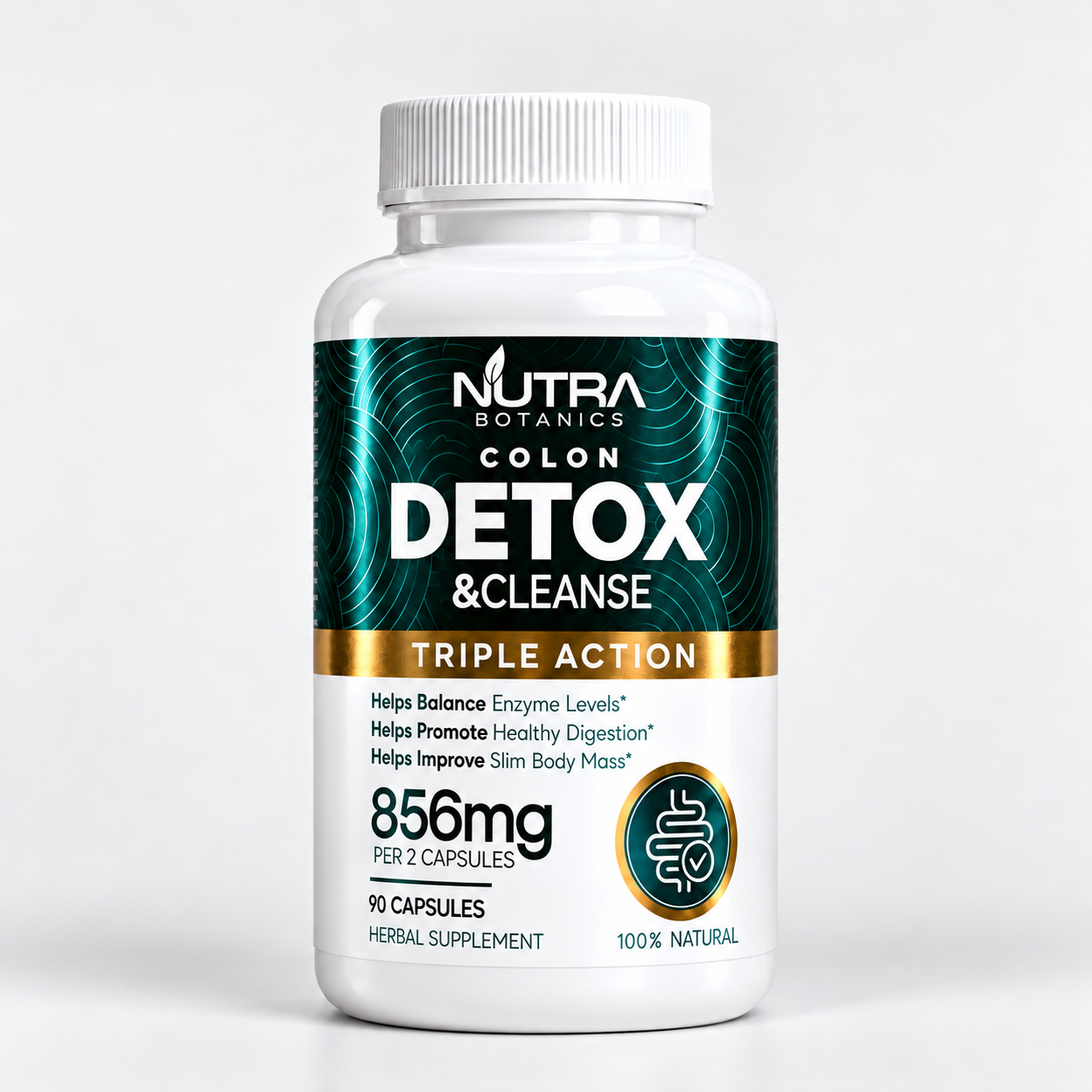
- Colon Detox & Cleanse lists an 856 mg total blend per two capsules, not 856 mg of psyllium.
- Its 90 capsules equal 45 labeled servings. That count is not a recommended continuous course.
What “detox” can and cannot tell you
NCCIH’s current detox guidance describes limited, generally low-quality human research on detox programs. It does not establish that commercial cleanses remove toxins or produce lasting weight loss. Increased bowel movements and an early change on the scale are not measurements of toxin elimination.
For an ingredient claim, ask a specific question: did the study measure stool frequency, a liver marker or an identified substance leaving the body? These outcomes are different. A mechanism described in a laboratory is also different from a clinical result in the people who would buy the product.
| Claim or ingredient | What to look for | What it does not establish |
|---|---|---|
| Psyllium or other fiber | Bowel outcomes with the stated fiber amount and population | Toxin removal from a multi-ingredient capsule |
| Milk thistle or NAC | The specific preparation, condition and measured outcome | The same effect from a different formula in a healthy shopper |
| Probiotic blend | Strain, viable amount and a matching human study | A benefit shared by every probiotic species or blend |
| “Cleanse” or “reset” | A named, measurable benefit and a complete label | A treatment plan or a proven whole-body effect |
What the Klein and Kiat review actually examined
The 2015 critical review by Klein and Kiat examined commercial detox diets for toxin elimination and weight management. The authors found little clinical evidence and reported that, to their knowledge, no randomized trial had tested commercial detox diets in humans at that time. Small studies had important methodological limitations.
Its scope matters. This was a review of detox diets, not proof that every medical treatment or bowel-support ingredient is ineffective. It also cannot be used as an up-to-date inventory of every supplement trial. Read the intervention and outcome before applying a study’s conclusion to a bottle on a shelf.
Milk thistle: promising mechanisms, mixed clinical findings
Milk thistle extract contains silymarin, a mixture of compounds. The 2018 Abenavoli review describes its chemistry and possible biological actions, while calling for stronger randomized trials to establish clinical value. Those proposed mechanisms are not a reason to promise liver recovery.
A 2012 randomized trial in 154 people with chronic hepatitis C found that the tested silymarin treatments did not improve the primary liver-enzyme outcome compared with placebo. A 2019 trial in 78 people with nonalcoholic steatohepatitis also found no significant benefit on its primary disease-activity endpoint; important enrollment limitations complicated interpretation.
NCCIH’s milk thistle summary describes liver-disease results as conflicting or too limited for firm conclusions. It also notes digestive side effects, possible allergies and potential medicine interactions. These are disease-specific studies, not evidence that an everyday cleanse protects against heavy drinking or medication-related injury.
NAC and glutathione: keep the treatment context
N-acetylcysteine supplies cysteine used to make glutathione. The 2007 Atkuri review discusses this role in glutathione-deficient and medical contexts, including acetaminophen toxicity. It reviews trials across different conditions. It is not a trial showing that a routine cleanse removes toxins from healthy adults.
Emergency poisoning treatment and an ordinary supplement purchase are different decisions. A clinical protocol should not become a self-directed “detox” dose. The current Colon Detox & Cleanse ingredient list contains neither NAC nor milk thistle, so this research does not establish an effect for that product.
Fiber, probiotics and popular cleanse claims
The 2023 AGA and ACG constipation guideline conditionally suggests fiber for adults with chronic idiopathic constipation, with low-certainty evidence. Of the fibers it evaluated, psyllium appeared useful. Hydration matters and gas can occur. This supports a specific bowel question, not a claim about flushing toxins.
The same guideline distinguishes different laxatives and treatment settings. It does not establish one universal seven-to-fourteen-day “safe cleanse” period, or show that every stimulant botanical blend is interchangeable with a studied treatment. Check the current product directions rather than assuming that a cleanse name defines its duration.
For probiotics, the NIH Office of Dietary Supplements explains why strain-specific findings matter. An ingredient name alone is not enough to match a trial. Check whether the product gives a strain identifier and viable count before comparing it with a research result.
- Ionic foot baths: a small 2012 study involving six healthy participants did not find the claimed specific release of toxic elements through the feet. A water-color change is not a clinical toxin test.
- Juice cleanses: the 2017 Obert weight-loss review connects initial losses with severe calorie restriction and notes that weight can return when normal eating resumes. That is not evidence of toxin removal or a guaranteed long-term change.
- Proprietary blends: a total weight does not disclose the amount of each ingredient. Compare what is actually stated, rather than assigning a studied single-ingredient dose to the entire blend.
Which research fits your goal?
A useful comparison starts with your reason for shopping. For bowel regularity, look at bowel outcomes and the amount of the relevant ingredient. For a liver-health concern, medical assessment answers a different question from browsing a cleanse category. A promising ingredient mechanism cannot identify who will get the “best results” from an untested blend.
Use the label checklist below to compare format and buying details, and the detoxification guide for the underlying biology. For the actual product, the current formula and label provide the purchase facts.
Colon Detox & Cleanse: the actual label
The blend lists cascara sagrada, oat straw, alfalfa, fennel, psyllium husk, horsetail, dandelion root, burdock, aloe ferox, parsley, Siberian ginseng, bentonite, cayenne and Bacillus coagulans. These facts were checked against the manufacturer label and current product page on October 11, 2026.
Do not read 856 mg as the psyllium dose, a probiotic count or proof that every listed ingredient matches a research amount. The label also does not turn 45 servings into a recommended 45-day course. Use the directions and warnings on the current bottle, and ask the manufacturer to clarify any conflicting instructions before use.
Check the formula before you choose
See the complete ingredient list, current directions, warnings and purchase options.
Explore Colon Detox & CleanseMake a useful, specific choice
Choose a product for a clearly stated purpose and evaluate that purpose against its actual formula. An ingredient study is not a clinical test of the finished blend. More ingredients, more bowel movements or a lower early scale reading do not, by themselves, demonstrate a more effective cleanse.
NCCIH notes that laxative-related diarrhea can cause dehydration and that colon-cleansing procedures can have serious risks. NIDDK’s constipation guidance advises prompt medical attention when constipation comes with problems such as rectal bleeding, blood in the stool, constant abdominal pain, vomiting or unexplained weight loss. These symptoms should not be treated as signs to buy a stronger cleanse.
Related reading: Colon Detox & Cleanse label, 7 Signs Your Gut Needs a Detox, Best Supplements for Liver Health, Natural detox foods: a food-first routine.
Frequently Asked Questions
Do detox supplements actually work?
What's the actual research on silymarin, NAC and psyllium?
How long should a detox or cleanse last?
Which detox ingredients have the strongest evidence?
Are detox supplements safe?
Can a supplement replace diet, hydration and sleep?
How much psyllium is in Colon Detox & Cleanse?
Does Colon Detox & Cleanse contain milk thistle or NAC?
Editor’s Note · October 11, 2026

Explore the formulas
Related Articles

Research and label sources
- NCCIH: detoxes and cleanses, current evidence and risks
- Klein and Kiat 2015: critical review of commercial detox diets
- Abenavoli 2018: milk thistle chemistry and clinical potential
- Fried 2012: randomized silymarin trial in chronic hepatitis C
- Navarro 2019: randomized silymarin trial in steatohepatitis
- NCCIH: milk thistle evidence and safety
- Atkuri 2007: NAC and glutathione-deficiency contexts
- AGA and ACG 2023: adult chronic idiopathic constipation guideline
- NIH Office of Dietary Supplements: probiotic evidence and strain identity
- Kennedy 2012: ionic footbath proof-of-principle study
- Obert 2017: review of four weight-loss strategies
- NIDDK: constipation symptoms that need medical assessment
Product facts checked against the manufacturer label NB961 (Detox and Colon Cleanse) and current product details on October 11, 2026. This is an editorial evidence check, not a qualified clinical review.
These statements have not been evaluated by the Food and Drug Administration. This product is not intended to diagnose, treat, cure, or prevent any disease.