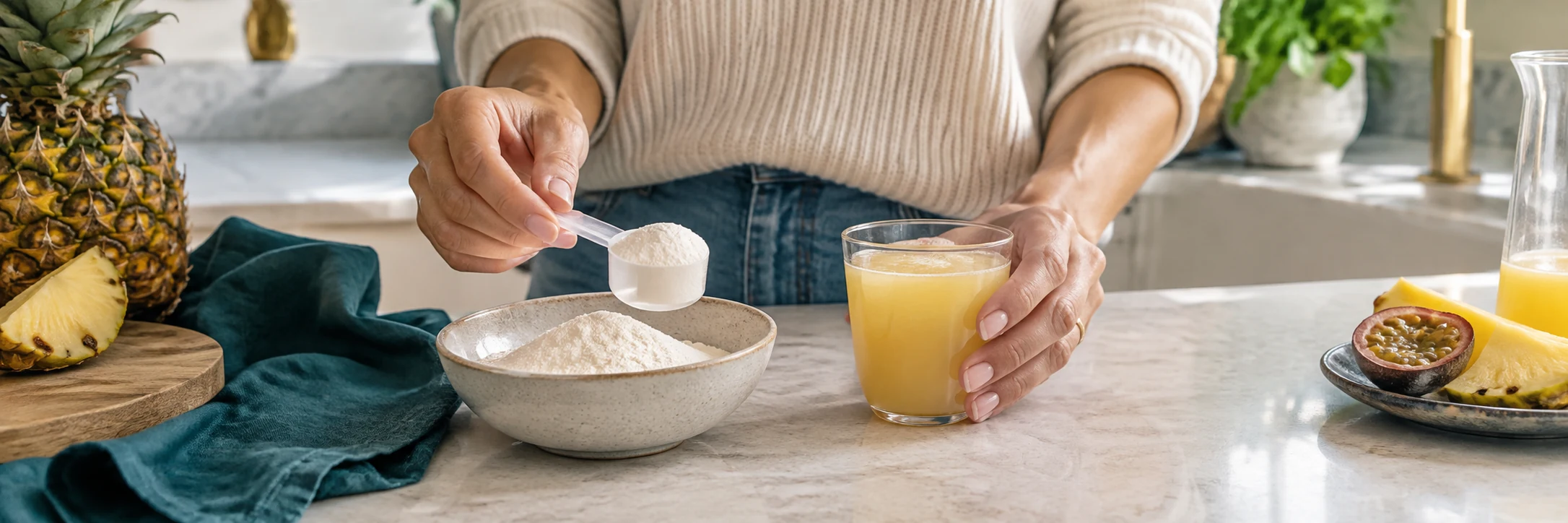
How much collagen should you take per day? Start with your product's complete directions. For Joint Plus, one 30 mL serving provides 6 g of collagen, or 6,000 mg. Studies have tested different amounts and preparations, so their numbers are not a universal daily prescription.
Three numbers worth checking
- Collagen amount: 6,000 mg and 6 g are the same amount.
- Serving size: 30 mL describes the liquid you measure, not 30 g of collagen.
- Bottle servings: a larger bottle gives you more servings. It does not automatically give you a stronger serving.
Read the serving before comparing the dose
Find the collagen line on the Supplement Facts panel. Compare that amount with the serving size and full directions. A scoop, capsule or spoonful can contain very different amounts, even when two products use the same big number on the front.
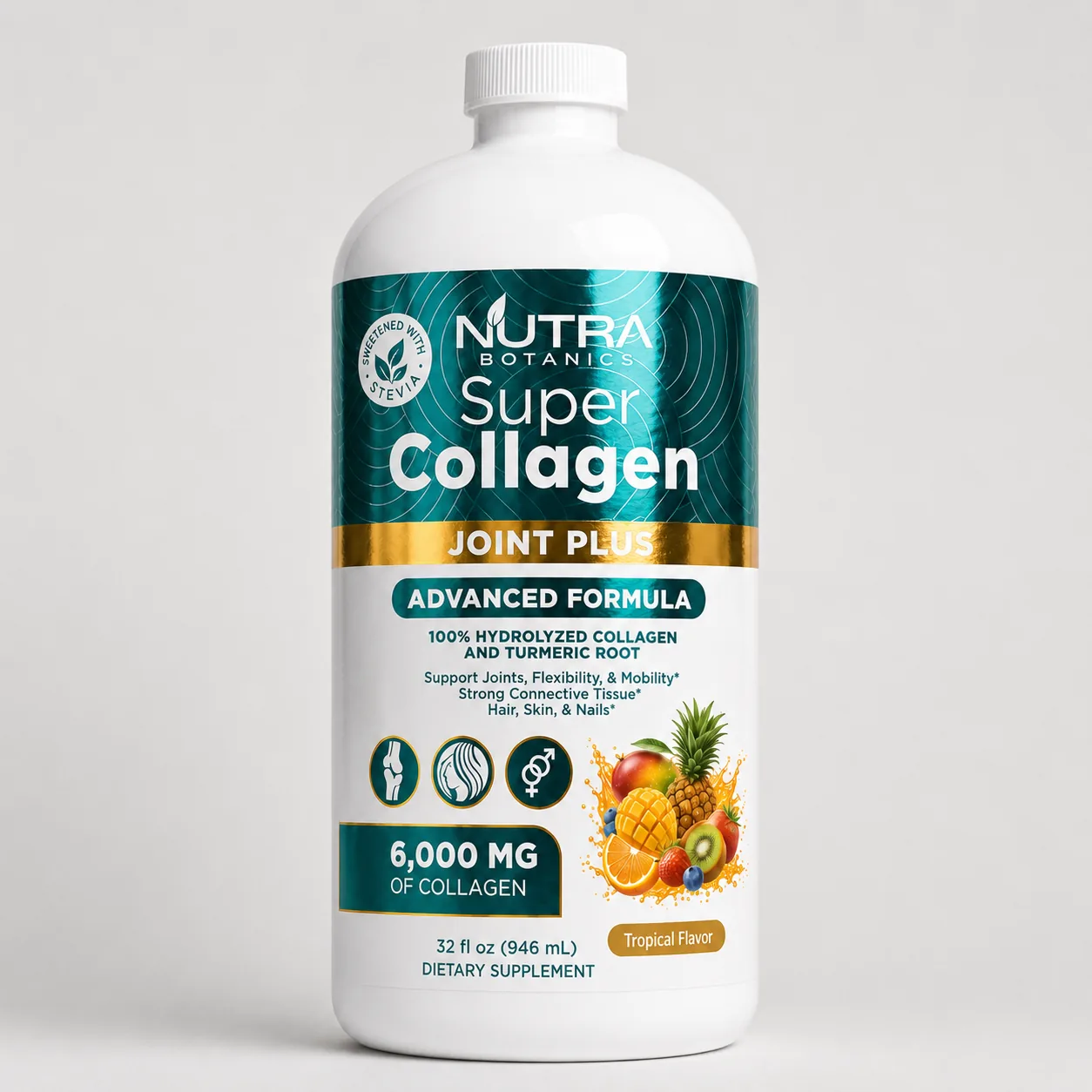
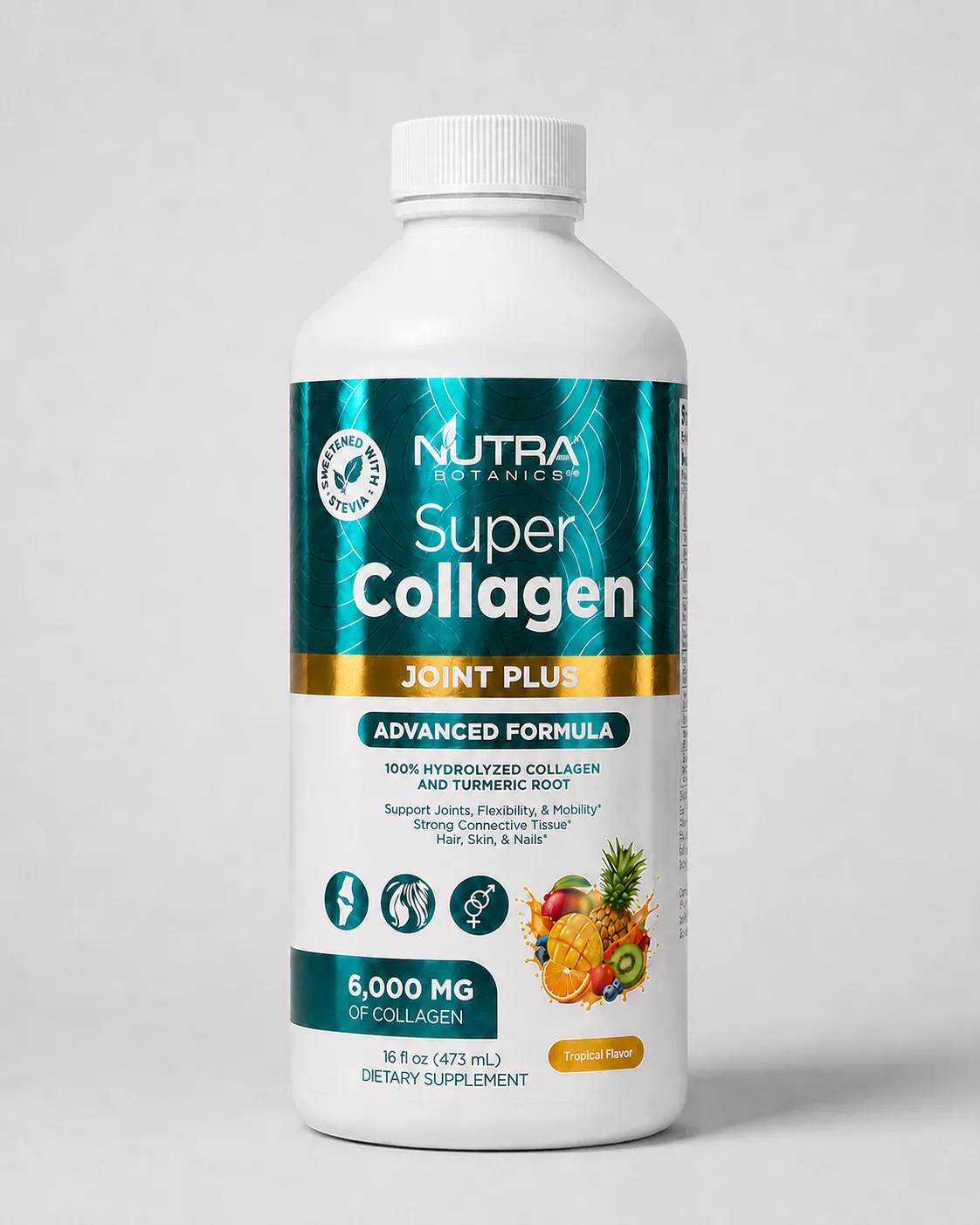
Joint Plus lists 6 g of hydrolyzed collagen per 30 mL. Hydrolyzed means the collagen has been broken into smaller protein pieces, called peptides. Its label also lists vitamin C and other ingredients, so review the whole blend rather than collagen alone.
Undenatured type II collagen is a different preparation that retains its original structure. A 2016 trial tested 40 mg of the UC-II ingredient daily in people with knee osteoarthritis. That ingredient amount is not interchangeable with grams of hydrolyzed collagen.
What daily amounts have studies tested?
These are examples of research servings, not instructions for your bottle. Each study used a particular preparation and group of people. The follow-up period tells you how long researchers measured outcomes, rather than when you should expect a result.
| Study focus | Daily amount (g) | What was measured |
|---|---|---|
| Skin | 2.5 g or 5 g daily | 69 women, eight weeks. Both peptide groups improved elasticity compared with placebo. Moisture findings were not statistically significant. |
| Joints | 10 g daily | CH-Alpha, 24 weeks. Several pain measures improved compared with placebo. Researchers could evaluate 97 of 147 enrolled athletes. |
| Nails | 2.5 g daily | VERISOL, 25 people, 24 weeks. Nail growth and breakage improved, but there was no comparison group. This was not a hair-growth study. |
| Digestion | 20 g daily | Peptan, eight weeks. Thirteen of 14 completers reported fewer symptoms. Forty were recruited, there was no comparison group, and supplier Rousselot funded the study. |
| Muscle | 15 g daily | 53 older men, 12 weeks. The collagen group had bigger gains in strength and body weight excluding fat. All participants followed a training program. |
Study quality matters as much as the amount. A 2025 skin review found favorable results overall, but no significant improvements in its higher-quality or non-pharmaceutical-funded subgroups. Use the collagen research guide to look beyond a headline dose.
A 2025 correction to the muscle trial disclosed Gelita's sample and cost support, plus a related patent application naming one author as a co-inventor. Those details belong alongside its results.

Bone and tendon studies: look at the actual test
Bone density: a 2018 trial enrolled 131 postmenopausal women with reduced bone density and tested 5 g of specific collagen peptides daily for 12 months. Bone density improved compared with placebo. This does not create an age-based dose rule or establish treatment with another formula.
Exercise and tendon research: a small 2017 study tested 5 g or 15 g of vitamin C-enriched gelatin in eight men. The higher amount increased a blood marker linked to collagen formation after exercise.
Researchers also tested lab-grown ligaments using blood samples. They did not measure healed injuries in the participants. A change in a blood marker is different from proof of faster tendon repair.
Absorption does not tell you the perfect amount
A human absorption study detected some collagen-derived peptides in blood after people consumed collagen hydrolysates. That helps explain digestion and absorption. It does not show that every absorbed gram reaches your skin or repairs a joint.
Compare the disclosed preparation and ingredients before paying more for a claim of “maximum absorption.” Our marine and bovine collagen guide explains source differences; source alone does not specify a personal daily amount.
Make the labeled serving fit your day
For Joint Plus, measure the liquid, shake well and keep the bottle refrigerated. Follow the complete directions on your current package. An empty stomach is not listed as a requirement on this label.
Vitamin C helps your body form normal collagen. Joint Plus lists 100 mg per 30 mL serving. That role of vitamin C does not mean you need an extra supplement or that timing doubles tendon repair.
Choose a time that fits your package directions and routine. Read more about collagen timing and foods that support collagen production.
Should age or training change your serving?
A birthday or a harder workout is not a reason to automatically add another serving. Start with your goal and the full label. Studies in older adults and athletes used different preparations, amounts and routines; they do not supply one dose chart for everyone.
Discuss personal changes with your healthcare professional, especially if you manage a health condition or take medication. For a broader view of popular goals, explore collagen and skin or the five-use collagen benefits guide.
Is more collagen always better?
Research servings are not permission to exceed your product's directions. Taking more of a multi-ingredient formula increases all its ingredients, not just the collagen. Check your other supplements too, so you know what you are combining.
The FDA advises checking supplement ingredients and possible interactions. If you experience an adverse reaction, stop using the product and seek medical advice. A trial using a higher amount does not establish that amount as safe for every person or blend.
What does 6,000 mg mean for your choice?
6,000 mg is 6 g. That is the collagen amount in one 30 mL Joint Plus serving. It is a clear number you can compare with other labels. The amount alone does not demonstrate the skin, hair or joint results of a finished formula.
- Match the preparation. Hydrolyzed collagen and undenatured type II ingredients are different.
- Match the outcome. A nail study does not establish hair growth, and a blood test does not demonstrate injury repair.
- Match your routine. Check the complete directions, storage and price per labeled serving.
Choose a bottle by servings and value
The 16 oz Joint Plus bottle lists 16 servings; the 32 oz bottle lists 32. Both provide 6 g of collagen and 100 mg of vitamin C per 30 mL serving. The larger bottle offers more servings, rather than a stronger serving.
Both also list glucosamine, MSM, chondroitin, turmeric, hyaluronic acid and tart cherry. Read the full panel and warnings before choosing this blend. The number of servings is a bottle fact; your complete directions determine how quickly you use them.
Compare the two Joint Plus sizes
See the labeled servings, current purchase options and price per serving side by side.
Compare Joint Plus bottle sizesYou can also browse all formulas or read what common collagen-related concerns can tell you before choosing.
*These statements have not been evaluated by the Food and Drug Administration. This product is not intended to diagnose, treat, cure, or prevent any disease. Individual results may vary.
Your serving questions, answered
Can I take too much collagen per day?
Should I split my collagen dose or take it all at once?
How much collagen is in bone broth?
Does the dose need to change as I get older?
Is more collagen always better?
How much collagen should I take per day?
Sources and safe use
Use the full label, rather than this guide, for product directions. Discuss the complete formula with your healthcare professional if you take medication, are pregnant or nursing, or manage a health condition.
Research used in this guide
- Skin elasticity trial, 2014
- Earlier skin outcomes review, 2021, and skin review with quality and funding analysis, 2025
- Activity-related joint trial, 2008
- Undenatured type II ingredient trial, 2016
- Nail study, 2017
- Digestive-symptom study, 2022
- Strength-training trial, 2015, with its disclosure correction, 2025
- Bone density trial, 2018
- Gelatin and exercise study, 2017
- Human absorption study, 2005
- NIH vitamin C fact sheet
- FDA supplement guidance

Explore the two Joint Plus bottles
Keep Exploring